

Indigenous Greek Grape Varieties

White Grapes

Assyrtiko

Assyrtiko is one of Greece’s most important indigenous white grape varieties. Originally from Santorini, it is now grown throughout many of Greece’s wine regions. One of its most distinctive qualities is its ability to retain remarkably high acidity even in hot, dry conditions, producing wines with freshness, structure and concentration rather than overt aromatic intensity.
On Santorini, Assyrtiko produces powerful, mineral-driven wines with citrus character, notable salinity, depth and excellent ageing potential. Outside Santorini, it generally retains its freshness and mineral character while showing more primary fruit and a somewhat lighter structure. Assyrtiko is most commonly made as a dry white wine, either unoaked or oak-aged, but it also plays an important role in traditional sweet wines such as Santorini’s Vinsanto.

Color: Pale lemon-yellow
Acidity:  High
Aromas & Flavors: Citrus fruits, green and stone fruits, mineral and saline notes
Body: Medium-full to full
Ageing Potential: 5–10+ years; top Santorini examples can age significantly longer
Wine Styles: Fresh and unoaked; oak-aged; bottle-aged; sweet wines from sun-dried grapes 
Food Pairing: Fish and seafood, grilled dishes, white meats and Mediterranean cuisine

Malagousia

Malagousia is one of the great success stories of the modern Greek wine renaissance. In the 1970s, this indigenous white grape variety was known to very few growers and was thought to be close to extinction. Thanks to the work of Greek academics and pioneering wine producers, it was rediscovered and brought back into commercial cultivation. Today, Malagousia is widely grown and produces distinctive dry white wines as well as a smaller number of rich sweet wines.
Malagousia is highly aromatic and expressive, typically showing peach, citrus fruit, fresh herbs and floral notes, sometimes with a characteristic hint of green pepper. On the palate, the wines are generally round and relatively full-bodied while retaining freshness, often with moderately high alcohol. Most examples are vinified in stainless steel to preserve their aromatic character, although some are fermented or matured in oak for greater texture and complexity. Sweet versions, often made from late-harvest grapes, are richer and more concentrated.

Color: Pale to medium lemon-green
Acidity: Medium
Aromas & Flavors: Peach, citrus fruits, fresh herbs, flowers and green pepper
Body: Medium to full
Ageing Potential: Best enjoyed relatively young; richer and sweet examples can develop for several years
Wine Styles: Fresh and unoaked; oak-fermented or oak-aged; sweet late-harvest wines
Food Pairing: Seafood, grilled fish, salads, vegetables, white meats and Mediterranean cuisine

Savatiano

Savatiano is one of Greece’s historic indigenous white grape varieties and has long been among the country’s most widely planted grapes, particularly in Attica and Central Greece. Traditionally associated with high-volume dry white wines and, above all, with Retsina, the variety is increasingly being recognized for its ability to produce distinctive wines when yields are controlled and the grapes come from well-managed, often older vineyards. It is used both as a varietal wine and in blends, including a number of PGI wines.
Savatiano typically produces dry white wines with aromas of lemon, yellow and stone fruits, fresh herbs and subtle grassy notes. On the palate, the wines are generally round and medium-bodied, with moderate acidity and a soft, balanced texture. Most examples are made in a fresh, unoaked style, while more ambitious wines can show greater concentration, complexity and ageing potential. Savatiano is also the principal grape traditionally used for Retsina and plays an important role in the modern revival of this distinctive Greek wine style.

Color: Pale lemon-yellow
Acidity: Medium
Aromas & Flavors: Lemon, yellow fruits, peach, apricot, fresh herbs and subtle grassy notes
Body: Medium
Ageing Potential: Best enjoyed relatively young; high-quality examples can develop for 5–7+ years
Wine Styles: Fresh and unoaked; more structured and age-worthy dry wines; Retsina
Food Pairing: Fish and seafood, salads, vegetable dishes, white meats and Greek and Mediterranean cuisine

Vilana

Vilana is one of Crete’s most important indigenous white grape varieties and is grown mainly in the regions of Heraklion and Lasithi. It is traditionally used to produce fresh, dry white wines, although some producers also make more structured, oak-aged versions. Vilana is particularly important in PDO Peza, where the white wines are made entirely from the variety, while in PDO Sitia it is blended with Thrapsathiri.
Vilana typically produces fresh, approachable wines with moderate aromatic intensity and notes of lemon, orange, pear, flowers and herbs. On the palate, the wines are generally light to medium-bodied, with moderate acidity, a soft texture and medium alcohol. Most examples are intended to be enjoyed young, while carefully made oak-aged versions can develop greater depth and complexity. Its fresh, balanced character makes Vilana particularly well suited to fish, seafood, vegetables and the varied dishes of Cretan and Mediterranean cuisine.

Color: Pale to medium lemon-yellow
Acidity: Medium
Aromas & Flavors: Lemon, orange, pear, peach, flowers and fresh herbs
Body: Light to medium
Ageing Potential: Best enjoyed within 3 years; oak-aged examples can develop for 5+ years
Wine Styles: Fresh and unoaked; oak-aged; varietal and blended dry white wines
Food Pairing: Fish and seafood, salads, vegetable dishes, white meats and Cretan and Mediterranean cuisine

Vidiano

Vidiano is one of Crete’s most promising indigenous white grape varieties and has become an important part of the island’s modern wine revival. Once little known outside its traditional growing areas, it has gained increasing attention as producers have recognized its considerable quality potential. Vidiano is used mainly to produce dry white wines, both in fresh, unoaked styles and in more structured versions fermented or aged in oak. 
Vidiano is characterized more by texture and structure than by overt aromatic intensity. Typical aromas include stone fruits, flowers and sweet herbs. On the palate, the wines are generally medium to full-bodied, with a creamy, mouth-filling texture and moderate to high alcohol, balanced by medium to high acidity. Despite their broad structure, well-made Vidiano wines retain freshness and balance rather than becoming heavy or flat.

Color: Pale to medium lemon-yellow
Acidity: Medium to high
Aromas & Flavors: Stone fruits, flowers and sweet herbs
Body: Medium to full
Ageing Potential: Best enjoyed relatively young; more structured and oak-aged examples can develop for several years
Wine Styles: Fresh and unoaked; oak-fermented or oak-aged; structured, textural dry white wines
Food Pairing: Fish and seafood, grilled vegetables, white meats and Cretan and Mediterranean cuisine

Robola

Robola is one of the most distinctive indigenous white grape varieties of the Ionian Islands and is particularly associated with Kefalonia, home to the PDO Robola of Kefalonia appellation. Its name and the islands’ proximity to Italy have historically led to comparisons with Ribolla Gialla, but genetic research indicates that Robola is a distinct variety, although the two may be closely related. On Kefalonia, Robola performs particularly well in poor limestone soils and higher-altitude vineyards, producing refined dry white wines with a strong sense of place.
Robola typically produces fresh, elegant wines with high acidity, medium body and aromas of lemon, grapefruit and flowers, often accompanied by mineral and subtle saline notes. Because the variety is prone to oxidation, careful winemaking is important, and many examples are vinified entirely in stainless steel to preserve their freshness and purity. The best wines combine vibrant acidity with minerality, finesse and a distinctive expression of Kefalonia’s terroir. 

Color: Pale to medium lemon-yellow
Acidity: High
Aromas & Flavors: Lemon, grapefruit, flowers, mineral and subtle saline notes
Body: Medium
Ageing Potential: Best enjoyed relatively young; high-quality examples can develop for 3–4+ years
Wine Styles: Fresh and unoaked; mineral-driven dry white wines
Food Pairing: Fish and seafood, shellfish, salads, vegetable dishes and Mediterranean cuisine

Dafni

Dafni is a rare indigenous white grape variety from Crete, particularly associated with the Heraklion region. Once close to extinction, it has been revived by a small number of producers and is now valued for its distinctive aromatic character and ability to produce flavorful wines without high alcohol. The variety takes its name from the Greek word for laurel, reflecting one of its most characteristic aromas. Plantings remain limited, although they have gradually increased, and Dafni is used mainly for varietal dry white wines rather than blends.
Dafni produces expressive wines with distinctive aromas of laurel, thyme, oregano and other herbs, complemented by citrus, yellow and white fruits, floral notes and subtle spices. On the palate, the wines are generally round and medium-bodied, with moderate acidity, good concentration and moderate alcohol. Most examples are made in a fresh, unoaked style, although small quantities are barrel-fermented, often using grapes from older vineyards. Dafni is best enjoyed relatively young, but well-made examples can develop additional complexity with several years of bottle age.

Color: Pale lemon-yellow
Acidity: Medium
Aromas & Flavors: Laurel, thyme, oregano, citrus fruits, yellow fruits, flowers and spices
Body: Medium
Ageing Potential: Best enjoyed within 3 years; high-quality examples can develop for up to 5–6 years
Wine Styles: Fresh and unoaked; limited barrel-fermented dry white wines
Food Pairing: Fish and seafood, salads, vegetable dishes, pasta, white meats and cheeses

Athiri

Athiri is an ancient indigenous white grape variety of the Aegean islands and has been used for centuries to produce dry white wines. It is particularly associated with the Cyclades and Dodecanese, where it contributes an elegant, fresh expression to the region’s white wines. Athiri is used both on its own and in blends, with some of its most notable expressions coming from Santorini, where it is traditionally blended with Assyrtiko and Aidani, and from the higher-altitude vineyards of Rhodes.
Athiri typically produces fresh, approachable wines with moderate aromatic intensity and notes of white and yellow fruits, citrus and flowers. On the palate, the wines are generally smooth and medium-bodied, with moderate alcohol, soft acidity and a lively, refreshing character. The variety is best suited to wines intended to be enjoyed relatively young, when its freshness and delicate fruit character are most expressive.

Color: Pale lemon-yellow
Acidity: Medium
Aromas & Flavors: Lemon, grapefruit, white and yellow fruits, floral notes
Body: Medium
Ageing Potential: Best enjoyed relatively young; generally within 3–4 years
Wine Styles: Fresh, smooth dry white wines; varietal and blended wines
Food Pairing: Fish and seafood, salads, vegetable dishes, light white meats and Mediterranean cuisine

Aidani

Aidani is an indigenous white grape variety of the Aegean islands, grown mainly in the Cyclades and particularly associated with Santorini. It is used to produce both dry and sweet white wines and is an important traditional blending partner for Assyrtiko. In PDO Santorini dry wines, Aidani can be used together with Athiri alongside a minimum of 85% Assyrtiko, while it also contributes to the island’s traditional Vinsanto. Pure varietal Aidani wines are less common but can offer a distinctive expression of the variety. 
Aidani typically produces elegant, moderately aromatic wines with notes of yellow and citrus fruits, flowers and subtle minerality. On the palate, the wines are generally medium-bodied, with moderate acidity and alcohol, and a soft, rounded texture. In blends with Assyrtiko, Aidani contributes roundness and floral complexity without overwhelming the mineral character of Santorini wines. Dry examples are usually best enjoyed relatively young, while richer wines can develop with bottle age and sweet versions have considerably greater ageing potential.

Color: Pale lemon-green
Acidity: Medium
Aromas & Flavors: Yellow fruits, citrus fruits, flowers and mineral notes
Body: Medium
Ageing Potential: Dry wines are best enjoyed relatively young; richer examples can develop for 5+ years, while sweet wines can age much longer
Wine Styles: Fresh and unoaked; varietal and blended dry white wines; sweet wines, including Vinsanto
Food Pairing: Seafood and shellfish, salads, vegetable dishes, white meats, pasta and cheeses 

Platani

Platani is a rare indigenous Greek white grape variety cultivated mainly in the southern Cyclades and western Crete, with a long-standing presence on Santorini. It is an early-ripening and relatively productive variety, although its susceptibility to botrytis can make vineyard management more demanding. On Santorini, Platani forms part of the island’s diverse traditional grape heritage. It is permitted in small proportions in PDO Santorini sweet wines and is also used in dry wines under the PGI Cyclades designation.

Color: Pale lemon-yellow
Acidity: Medium to high
Aromas & Flavors: Lemon, orange and other citrus fruits; ripe fruit and floral notes in some examples
Body: Medium
Ageing Potential: Best enjoyed relatively young
Wine Styles: Fresh dry white wines; blended wines; also permitted in traditional sweet wines from Santorini
Food Pairing: Fish and seafood, salads, vegetable dishes, appetizers and white cheeses 

Kontoura

Kontoura White is a rare local form of Savatiano traditionally cultivated in the Muses Valley near Askri, on the slopes of Mount Helicon in Boeotia, Central Greece. Samartzis Estate describes it as a unique local clone of Savatiano with a distinctive identity. Kontoura can be seen as a more refined, almost “aristocratic” expression of Savatiano, combining the variety’s naturally generous character with greater freshness and definition. 
Kontoura typically produces expressive dry white wines with citrus, tropical fruit and floral aromas, including lime, pineapple, melon, white flowers and lemon blossom. On the palate, the wines are generally medium-bodied, with medium to high, refreshing acidity, a crisp fruit character and a persistent finish. The variety can also respond well to oak ageing, developing greater texture and complexity while retaining its freshness, with additional notes of vanilla, butter and ripe fruit. 

Color: Pale to medium lemon-yellow
Acidity: Medium to high
Aromas & Flavors: Lime, citrus fruits, pineapple, melon, white flowers and lemon blossom
Body: Medium
Ageing Potential: Fresh styles are best enjoyed relatively young; oak-aged examples can develop for 3–4+ years
Wine Styles: Fresh dry white wines; single-varietal wines; oak-aged dry whites
Food Pairing: Fish and seafood, salads, vegetable dishes, poultry, light pasta dishes and mild cheeses

Pink Grapes

Moschofilero

Moschofilero is one of Greece’s most distinctive aromatic grape varieties. Although its berries have pink to grayish skins, it is traditionally vinified mainly as a white wine, while rosé expressions have become increasingly common. The variety is particularly associated with the high-altitude Mantinia Plateau in the Peloponnese, where the cool climate helps preserve its naturally high acidity and pronounced aromatic character. Moschofilero is used for both still and sparkling wines and can also be blended with other varieties to add freshness and aromatic intensity.
Moschofilero typically produces light to medium-bodied wines with vibrant acidity and an expressive floral and citrus-driven profile. Rose petals and citrus blossom are particularly characteristic, accompanied by orange peel, grapefruit and lime. The wines are generally fresh, elegant and highly aromatic, with a crisp, lively palate. Most are intended to be enjoyed relatively young, although well-made examples can develop additional complexity over several years. Its freshness and aromatic character make Moschofilero particularly well suited both as an aperitif and with elegant dishes based on seafood, vegetables, fresh herbs and gentle spices.

Color: Very pale pink to pale salmon in rosé wines; pale lemon when vinified as white
Acidity: High
Aromas & Flavors: Rose petals, citrus blossom, orange peel, grapefruit and lime
Body: Light to medium
Ageing Potential: Best enjoyed relatively young; generally 3–4 years
Wine Styles: Aromatic dry white wines; rosé wines; sparkling wines; blended wines
Food Pairing: Seafood, shellfish, salads, vegetable dishes, light pasta dishes, soft cheeses and Mediterranean cuisine

Roditis

Roditis is one of Greece’s most widely planted indigenous grape varieties and, despite its reddish-pink skins, is traditionally used mainly to produce white wines. It is grown in several parts of the country but is particularly important in the Peloponnese, especially Achaia, where it is the sole variety used for PDO Patra wines. Long associated with inexpensive everyday wines, Roditis can produce considerably more distinctive results when yields are controlled and grapes are grown in cooler, higher-altitude vineyards. It is also traditionally used in the production of Retsina.
Well-made Roditis typically produces fresh, elegant wines with citrus and floral aromas, often accompanied by melon and mineral notes. On the palate, the wines are generally light to medium-bodied, with medium to high acidity and a crisp, refreshing character. Most examples are made in a fresh, unoaked style and are best enjoyed relatively young. Its combination of freshness, versatility and generally accessible pricing has made Roditis an important part of everyday Greek wine culture as well as a variety capable of producing high-quality regional wines.

Color: Pale lemon-yellow in white wines; pale pink in rosé wines
Acidity: Medium to high
Aromas & Flavors: Citrus blossom, lemon, melon and mineral notes
Body: Light to medium
Ageing Potential: Best enjoyed relatively young; generally 3–4 years
Wine Styles: Fresh dry white wines; rosé wines; Retsina; blended wines
Food Pairing: Seafood, salads, vegetable dishes, white meats, pasta and cheeses

Red Grapes

Xinomavro

Xinomavro is one of Greece’s most important indigenous red grape varieties. Its name derives from the Greek words xino (“sour”) and mavro (“black”), referring to its naturally high acidity and dark-skinned berries, although the wines themselves are often relatively pale in color. The variety is particularly associated with Northern Greece and with appellations such as Naoussa and Amyndeon. Xinomavro is remarkably versatile, producing age-worthy dry red wines as well as rosé, sparkling and, more rarely, sweet wines.
Xinomavro is distinguished by its high acidity, firm tannins and unmistakably complex savory aromatic profile. Sun-dried tomato and black olive are among its most characteristic aromas, accompanied by red berries, sour cherry, dried plum and floral notes. With bottle age, the wines can develop tobacco, dried herbs, mushrooms, earthy notes and nuts, while oak ageing may contribute subtle spice. Young red wines can be austere and tightly structured, but the best examples develop slowly, gaining remarkable complexity, elegance and depth with age.

Color: Pale to medium ruby
Acidity: High
Tannins: High and firm; often austere when young
Aromas & Flavors: Sun-dried tomato, black olive, red berries, sour cherry, dried plum, flowers, tobacco and savory notes
Body: Medium
Ageing Potential: 10+ years; top examples can develop for considerably longer, gaining notes of tobacco, mushrooms, dried fruit and earthy complexity
Wine Styles: Age-worthy dry red wines; rosé wines; sparkling wines; occasional sweet wines
Food Pairing: Lamb, beef, game, tomato-based dishes, mushrooms, roasted vegetables and aged cheeses

Agiorgitiko

Agiorgitiko is one of Greece’s most important indigenous red grape varieties and is particularly associated with PDO Nemea in the Peloponnese, Greece’s largest PDO zone for red wine. The variety is remarkably versatile, producing styles that range from fresh rosé and youthful, fruit-driven red wines to structured, oak-aged reds with considerable ageing potential, as well as smaller quantities of sweet wines. Young Agiorgitiko typically emphasizes fresh red fruit, moderate acidity and supple tannins, while more ambitious examples gain depth, structure and complexity through oak and bottle ageing.
Agiorgitiko is characterized by ripe red-fruit aromas, particularly cherry and raspberry, often accompanied by sweet spices. Youthful wines are generally juicy, smooth and approachable, while oak-aged examples can develop notes of coffee, chocolate and spice, together with firmer but ripe tannins and a fuller structure. The best age-worthy wines combine concentrated fruit with freshness, depth and well-integrated tannins, allowing them to develop considerable complexity over a decade or more.

Color: Medium to deep ruby-purple
Acidity: Medium
Tannins: Medium and generally soft in youthful wines; firmer and more structured in age-worthy styles
Aromas & Flavors: Red fruits, cherry, raspberry, sweet spices, coffee and chocolate
Body: Medium; fuller in structured, oak-aged wines
Ageing Potential: Fresh styles are best enjoyed young; oak-aged examples can develop for 3–5 years, while top structured wines can age for 10+ years
Wine Styles: Fresh, fruit-driven red wines; oak-aged and age-worthy reds; rosé wines; sweet wines
Food Pairing: Poultry, lamb, beef, game, pasta, moderately spicy dishes and cheeses

Mandilaria

Mandilaria is an indigenous red grape variety particularly associated with the Aegean Islands and Crete. It plays an important role in several PDO wines, including Peza, Archanes, Paros and Rhodes, and is often used in blends because of its deep color, high tannins and firm structure. On Paros it is traditionally blended with the white Monemvassia, while in Crete it is commonly paired with the softer Kotsifali. Single-varietal Mandilaria wines are less common, although well-made examples can show considerable character and ageing potential.
Mandilaria typically produces deeply colored wines with medium body, medium to high acidity and powerful tannins that can be distinctly astringent when young. Its aromatic profile tends toward ripe dark fruit, plum, dried herbs, earthy and savory notes, often with a characteristic hint of leather. With bottle age, the tannins soften and the wines can develop greater complexity, showing dried fruit, herbs, spices and more evolved earthy notes. Its strong color and tannic structure make Mandilaria an important blending variety as well as a distinctive expression of the warm, windswept vineyards of the Greek islands.

Color: Deep ruby to purple
Acidity: Medium to high
Tannins: High and firm; often strongly astringent when young
Aromas & Flavors: Ripe dark fruits, plum, dried herbs, leather, earthy and savory notes, spices
Body: Medium
Ageing Potential: 5–10+ years; structured examples can develop for longer
Wine Styles: Dry red wines; blended reds; single-varietal reds; rosé wines; occasional sweet wines
Food Pairing: Lamb, beef, game, grilled meats, meat-based pasta dishes and aged cheeses

Kotsifali

Kotsifali is one of Crete’s most important indigenous red grape varieties and is closely associated with the island’s traditional red-wine styles. On its own, it typically produces relatively pale-colored wines with generous aromas, moderate to high alcohol, soft tannins and comparatively low acidity. Because of this naturally supple structure, Kotsifali is frequently blended with more deeply colored and firmly structured varieties, most traditionally Mandilaria. It plays an important role in Cretan appellations such as PDO Peza and PDO Archanes.
Kotsifali is valued for its aromatic character and soft, rounded texture. Typical aromas include cherry, blackberry and other ripe red and dark fruits, often accompanied by floral notes, dried fruit, herbs and warm spices. The wines are generally medium-bodied, smooth and approachable, with gentle tannins and few hard edges. Most are intended for relatively early drinking, although well-made examples and structured blends can develop additional complexity with bottle age, showing dried fruit, herbs and spice.

Color: Pale to medium ruby
Acidity: Low to medium
Tannins: Low to medium; generally soft and supple
Aromas & Flavors: Cherry, blackberry, ripe red and dark fruits, flowers, dried fruit, herbs and spices
Body: Medium
Ageing Potential: 3–5 years; structured examples and blends can develop for longer
Wine Styles: Soft, fruit-driven dry red wines; blended reds; occasional single-varietal reds
Food Pairing: Pork, poultry, veal, grilled meats, tomato-based dishes, roasted vegetables and medium-aged cheeses

Liatiko

Liatiko is one of Crete’s most distinctive indigenous red grape varieties, cultivated across the island and particularly associated with PDO Dafnes and PDO Sitia. It produces both dry and sweet red wines, but is especially renowned for its concentrated sweet wines made from sun-dried grapes. Despite being a red variety, Liatiko typically gives relatively pale-colored wines, often developing garnet or brick-red hues. Dry wines are generally soft and rounded, with relatively high alcohol and gentle tannins, while the sun-dried sweet wines are considerably richer and more concentrated.
Liatiko typically shows ripe red fruit, dried cherry and plum, often accompanied by dried figs, sweet spices, Mediterranean herbs and earthy notes. With age, the wines can develop more complex aromas of dried and candied fruit, spice, leather and savory herbs. Liatiko has considerable ageing potential: well-made dry wines often benefit from several years in bottle and can develop for a decade or more, while the best sun-dried sweet wines are capable of evolving for decades. 

Color:
Pale to medium garnet-red; often developing brick-red hues with age
Acidity: Medium
Tannins: Low to medium; generally soft
Aromas & Flavors: Ripe red fruits, dried cherry, plum, dried figs, sweet spices, Mediterranean herbs, earthy notes and leather
Body: Medium to full
Ageing Potential: Dry wines 5–10+ years; top sun-dried sweet wines can develop for decades
Wine Styles: Soft, complex dry red wines; sun-dried sweet red wines; occasional fortified sweet wines

Limniona

Limniona is one of Greece’s most promising indigenous red grape varieties. Originating in Thessaly, particularly around Karditsa and Tyrnavos, the variety was once close to disappearing before its quality potential was rediscovered through research and experimental vinifications. Today it is cultivated in several parts of Greece, although its strongest historical association remains with Thessaly. Limniona is used primarily for dry red wines and is valued for its ability to combine concentration and structure with freshness and elegance.
Limniona typically produces deeply colored, vivid ruby-purple wines with expressive aromas of red fruits, herbs, spices and mineral or earthy notes. On the palate, the wines are generally medium-bodied and concentrated, with bright acidity and firm, textured tannins that remain refined rather than aggressive. This combination of fruit, acidity, tannic structure and concentration gives Limniona considerable balance and ageing potential without making the wines feel excessively heavy. Well-made examples can develop additional complexity in bottle over a decade or more.

Color: Deep ruby-purple
Acidity: Medium to high
Tannins: Medium to high; firm and textured but generally refined
Aromas & Flavors: Red fruits, herbs, spices, vegetal notes, mineral and earthy notes
Body: Medium
Ageing Potential: 5–10+ years; top examples can develop for a decade or longer
Wine Styles: Fruit-driven and concentrated dry red wines; fresh or oak-aged styles; occasional rosé wines
Food Pairing: Beef, lamb, game, other rich red meats, pasta dishes and aged cheeses

Mavrodaphne

Mavrodaphne is one of Greece’s most distinctive indigenous red grape varieties, historically associated with the sweet fortified wines of the northern Peloponnese and Kefalonia. The variety became widely known through the sweet Mavrodaphne first vinified by Gustav Clauss near Patras in the 19th century and remains the basis of PDO Mavrodaphne of Patras and PDO Mavrodaphne of Kefalonia. Most plantings are found in the northwestern Peloponnese, particularly around Patras, with an important smaller center on Kefalonia. Although traditionally identified with fortified sweet wines, Mavrodaphne is increasingly used to produce distinctive dry red wines, particularly on Kefalonia.
Mavrodaphne typically produces deeply colored wines with aromas of ripe and dried dark fruit, especially cherry, dried plum and currant, accompanied by herbs, bay leaf, spices and earthy or leathery notes. Dry wines can combine medium acidity with medium to high tannins and a firm, savory structure, while the classic sweet styles are richer, fuller and softer in texture. Mavrodaphne responds particularly well to ageing: mature wines can develop considerable complexity, with notes of dried fig, coffee, chocolate, caramel, spices and fruitcake. The best fortified sweet examples are capable of evolving for decades, while serious dry wines can also develop beautifully in bottle. 

Color: Deep ruby to garnet
Acidity: Medium
Tannins: Medium to high; generally firmer in dry wines
Aromas & Flavors: Cherry, dried plum, currant, bay leaf, herbs, spices, dried fig, leather and earthy notes
Body: Medium to full
Ageing Potential: Dry wines 5–10+ years; top fortified sweet wines can develop for decades
Wine Styles: Fortified sweet red wines; complex dry red wines; aged styles
Food Pairing: Dry wines with beef, lamb, game, slow-cooked meats and aged cheeses; sweet styles with chocolate, dried-fruit and nut desserts

Mavrotragano

Mavrotragano is a rare indigenous red grape variety from Santorini whose name derives from the Greek words mavro (“black”) and tragano (“crisp”), referring to its dark, firm-skinned berries. Once close to extinction and traditionally used in small quantities in local sweet wines, the variety was rediscovered and propagated from a handful of surviving old vines. Today, Mavrotragano is regarded as one of Santorini’s most distinctive red varieties and is used primarily to produce structured, age-worthy dry red wines. Although still closely associated with Santorini, it is now also cultivated in small quantities elsewhere in Greece.
Mavrotragano typically produces deeply colored, concentrated wines with aromas of ripe red and black fruits, flowers, spices, coffee and smoke, often accompanied by mineral, earthy and leathery notes. The palate is generally full-bodied, with firm acidity, powerful tannins and a pronounced mineral character reflecting Santorini’s volcanic soils. The tannins can be formidable when young, but well-made wines gain harmony and complexity with bottle age. Its combination of concentration, structure, freshness and distinctive savory character gives Mavrotragano considerable ageing potential.

Color: Deep ruby to purple
Acidity: Medium
Tannins: High and firm; often powerful when young
Aromas & Flavors: Red and black fruits, flowers, spices, coffee, smoke, leather, mineral and earthy notes
Body: Full
Ageing Potential: 10+ years; top examples can develop for considerably longer
Wine Styles: Structured dry red wines; oak-aged and age-worthy reds
Food Pairing: Beef, lamb, game, grilled meats, slow-cooked meat dishes and aged cheeses

Mouhtaro

Mouhtaro is an exceptionally rare indigenous red grape variety from Central Greece, historically associated with the Muses Valley around Askri, on the southern slopes of Mount Helicon in Boeotia. The variety came close to disappearing as growers increasingly replaced its low-yielding vines with more productive varieties, but it survived in a small number of old vineyards and was gradually revived by local producers. Today, Mouhtaro is regarded as one of Central Greece’s most distinctive indigenous red varieties and is used to produce both dry red and rosé wines, as well as blends with other red varieties. 
Mouhtaro typically produces deeply colored wines with vibrant acidity and surprisingly soft, silky tannins. Its aromatic profile combines ripe red and dark fruits with wild berries, sour cherry, floral notes such as violet, herbs and spices. More structured examples can be full-bodied and concentrated, while oak ageing may add notes of chocolate, cocoa and sweet spices. Despite its depth and concentration, the variety retains freshness, and the best dry red wines have considerable ageing potential, developing greater complexity over a decade or more. Mouhtaro can also produce fresh, expressive rosé wines with bright fruit and lively acidity. 

Color: Medium to deep ruby-purple
Acidity: Medium to high
Tannins: Low to medium; generally soft and silky
Aromas & Flavors: Red and dark fruits, wild berries, sour cherry, violet, herbs and spices
Body: Medium to full
Ageing Potential: Structured red wines 10+ years; rosé styles are best enjoyed young
Wine Styles: Dry red wines; oak-aged and age-worthy reds; rosé wines; red blends
Food Pairing: Beef, lamb, game, sausages, tomato-based pasta dishes and aged hard cheeses

Greek Wine Law — Key Terms

Greek wine law includes a number of protected traditional terms defining how certain wines are aged and presented. Reserve and Grande Reserve are used for PDO wines, while Cava is a protected traditional term for Greek PGI wines.

Reserve — PDO

White wines: minimum 1 year of total aging, including at least 6 months in oak barrels and 3 months in bottle. Oak barrels may have a maximum capacity of 600 liters.

Red wines: minimum 2 years of total aging, including at least 12 months in oak barrels and 6 months in bottle. No maximum barrel size is specified.

Grande Reserve — PDO

White wines: minimum 2 years of total aging, including at least 12 months in oak barrels and 6 months in bottle. Oak barrels may have a maximum capacity of 600 liters.

Red wines: minimum 4 years of total aging, including at least 18 months in oak barrels and 18 months in bottle. No maximum barrel size is specified.

Cava — PGI

White wines: at least 6 months in oak barrels and 6 months in bottle.

Red wines: at least 1 year in oak barrels and 1 year in bottle.

Greek Cava should not be confused with the  Spanish Cava. In Greece, Cava (Κάβα) is a traditional labeling term for aged PGI wine and refers to aging under controlled conditions. In Spain, Cava is a separate PDO for quality sparkling wine. They are two different wine-law concepts that happen to use the same word.

Other Traditional Label Terms

Greek PDO and PGI wines may also use a number of protected traditional terms related to their origin or estate, including terms corresponding to estate, vineyard, high-altitude vineyard, monastery, castle, manor, and similar designations, provided the applicable requirements are met.
Greek Wine Classification

Greek wines are classified into four main categories:

PDO — Protected Designation of Origin

33 appellations with the strictest rules regarding geographical origin, permitted grape varieties and production methods.

PGI — Protected Geographical Indication

120 appellations representing a broader range of Greek wine regions and styles. This category also includes wines bearing a Traditional Designation and a specified geographical indication — Verdea and Retsina.

Varietal Wines

Wines without a PDO or PGI geographical indication, identified primarily by grape variety. The grape variety and vintage may be stated on the label.

Wines Without PDO/PGI

Wines without a PDO or PGI geographical indication that do not fall within the Varietal Wines category. The grape variety or vintage is not stated on the label.

Key Greek PDO Appellations

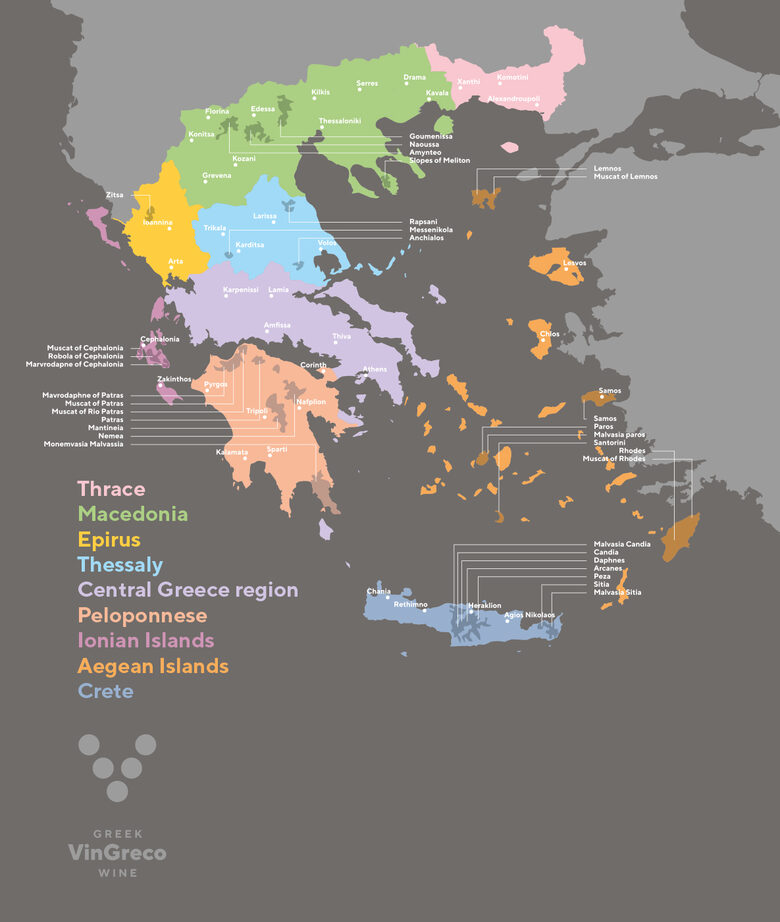
Some of the most important Greek PDO appellations are:  Santorini PDO — Assyrtiko, Nemea PDO — Agiorgitiko, Mantinia PDO — Moschofilero, Naoussa PDO — Xinomavro, Amyndeon PDO — Xinomavro.


Traditional Designation Wines

Retsina A traditional Greek wine made from grape must with the addition of Aleppo pine resin (Pinus halepensis). The resin may account for 0.15–1.0% of the wine’s final volume. Although Retsina may be produced throughout Greece, only Retsina produced in certain regions of Central Greece may bear one of 15 protected geographical indications (PGIs) on the label.

Verdea A traditional oxidized white wine from the Ionian island of Zakynthos. Its production must meet specific requirements concerning permitted grape varieties, vineyard yield and the sugar content of the must. Traditional grape varieties used include Skiadopoulo, Pavlo and Avgoustiatis.

Map of Greek PDO Appellations

Greek wine appellations